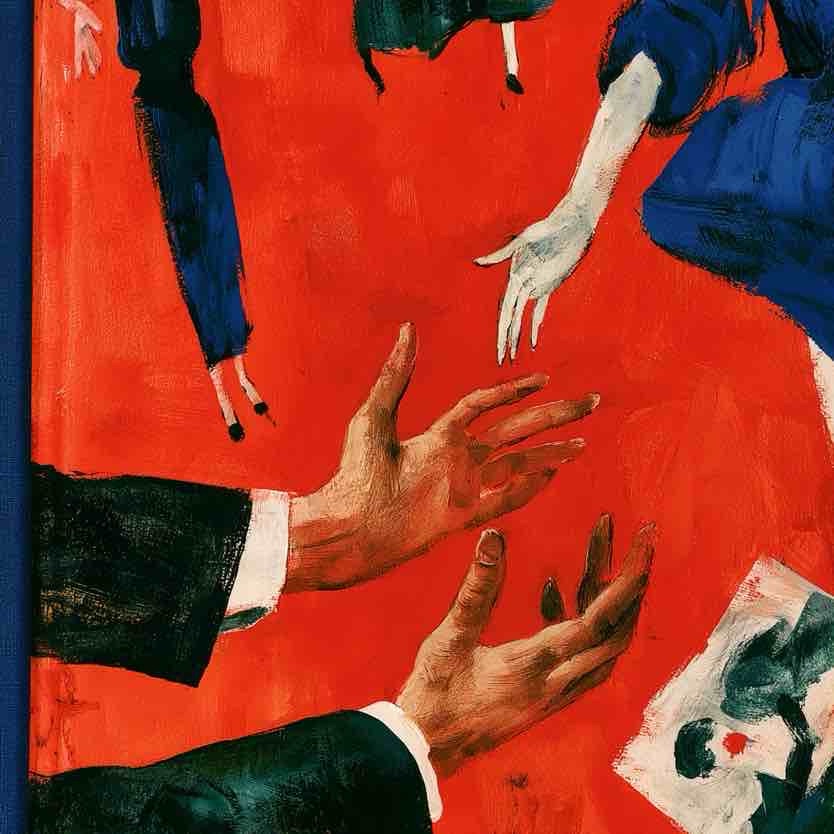
There is a special kind of optimism that comes with dialing into a peer-to-peer. You straighten in your chair. You pull up the chart. You rehearse the clinical logic you’ve already documented twice, sometimes three times, for people who may never read it. You imagine, perhaps naively, that on the other end will be a true peer. Someone who speaks your clinical language. Someone who understands why this MRI, this surgery, this consult, this medication actually matters for the human attached to the chart.
And then the call starts.
Within sixty seconds you realize this is not a peer conversation in the traditional sense of the word. It’s closer to improv theater, with a vague script, unclear rules, and an audience that cannot be convinced no matter how compelling the performance. Which is why many physicians have quietly renamed the process in their own heads. Peer-to-peer may be the official term, but honesty invites a richer vocabulary.
Let’s start with the most accurate working title: Authorization Theater. Everyone has lines. Everyone plays their role. The ending was determined long before the curtain rose. You deliver your evidence-based monologue. The reviewer politely acknowledges your words. The policy remains unmoved. Somewhere backstage, a utilization guideline written by someone you will never meet holds the real power. Applause optional.
Then there’s Utilization Roulette. You spin the wheel and discover which mystery clinician appears on the line today. Will it be someone adjacent to your specialty? A generalist valiantly trying to interpret subspecialty nuance? A well-meaning professional who hasn’t practiced clinically in years? The unpredictability becomes part of the sport. You prepare for everything and still manage to be surprised.
Sometimes the call evolves into Guess Who’s on the Line? You gently probe. You ask about training, experience, scope. You piece together clues like a medical detective. By the time you understand who you’re actually speaking with, half the allotted time has evaporated and you’re still explaining why a spine problem involves, well, a spine.

On especially memorable days, the experience becomes Clinical Telephone. Your original indication morphs as it travels through layers of documentation, call scripts, internal summaries, and policy interpretations. By the time it lands in front of the reviewer, the story resembles a distant cousin of reality. You spend precious minutes reconstructing the actual clinical picture before the clock runs out.
Many physicians have experienced the endurance sport known as The Administrative Olympics. Mental stamina is tested. Patience is stretched. Communication hurdles appear without warning. The scoring system remains mysterious. There are no medals, only the faint hope of an approval email arriving later that day.
Others prefer the metaphor of The Prior Auth Escape Room. Solve three riddles, decode two policy clauses, explain anatomy with the enthusiasm of a first-year lecturer, and maybe the door unlocks. Or maybe a new puzzle appears just as you think you’re free.
Occasionally, the call feels like Policy vs Physiology. Two intelligent frameworks collide. One is grounded in lived patient complexity, uncertainty, and individualized care. The other lives inside rigid algorithms designed for predictability and cost containment. Both sides speak confidently. Neither fully persuades the other.

Then there’s the social experiment known as The Credential Mismatch Mixer. Everyone shows up wearing invisible nametags that don’t quite align. Conversation remains polite. The connection feels… aspirational. You leave knowing more about how different worlds interpret the same word: “appropriate.”
Some days earn the title Not-Quite-Peer Review. Peer-adjacent. Peer-inspired. Peer in spirit, perhaps. It’s no one’s fault individually, yet the mismatch quietly erodes the credibility of the process itself.
And finally, for the truly philosophical among us, peer-to-peer becomes Existential Medicine. What is a peer? Who defines expertise? Where does clinical judgment live in a system optimized for utilization management rather than patient nuance? Why does explaining the same indication repeatedly still feel vaguely like performance art?
Despite the humor, there is something genuinely revealing about how universally recognizable these experiences are across specialties. Orthopedists, family physicians, psychiatrists, internists, surgeons, pediatricians, emergency physicians, all tell different versions of the same story. The details change. The emotional rhythm does not. Confusion, mild disbelief, restrained professionalism, and the quiet recalibration of expectations become familiar companions.


The irony is that the idea behind peer-to-peer makes sense on paper. Clinical review should involve clinicians. Thoughtful utilization oversight can prevent unnecessary interventions and support high-value care. Collaboration between physicians should, in theory, elevate decision-making. In practice, the execution often resembles a loosely coordinated group project where no one received the same assignment.
What keeps this from tipping fully into cynicism is the shared humor physicians bring to it. Naming the absurdity gives it shape. Laughing at the structural mismatch allows space to release the tension without turning it into bitterness. Humor becomes a form of resilience, a small act of reclaiming agency in a process designed without much clinician input.
It also sparks important conversations. Why aren’t reviewers consistently matched by specialty or meaningful clinical proximity? Why does documentation repeatedly outweigh direct clinical dialogue? How much time, energy, and cognitive load is being siphoned away from patient care into administrative theater? These questions don’t disappear just because we joke about them. If anything, humor lowers the barrier for honest discussion.

And maybe that’s the hidden value of renaming the experience. When we call something what it feels like, we illuminate the gap between intention and reality. We invite reform not through outrage, but through shared recognition. The laughter carries truth inside it.
So the next time you find yourself dialing into another peer-to-peer, you might quietly ask yourself which game you’re about to play. Authorization Theater? Utilization Roulette? The Escape Room? The Administrative Olympics? Pick your favorite. Pour your coffee. Take a breath. Deliver your best performance with grace and clarity.
And when the call ends, feel free to add another creative title to the growing library of physician folklore. At this point, we’ve earned it.