There are certain objects that survive a medical career for reasons that are difficult to explain to anyone who was not there.
They migrate from apartment to apartment, from residency to fellowship, from one office drawer to another. They end up in boxes that are opened every few years and then carefully closed again. Some sit in plain sight on a bookshelf. Others have been carried for so long that their owners may no longer remember making a conscious decision to keep them.
An old identification badge. A pen. A stethoscope that has long since been replaced by a better one. A note written on paper that has begun to soften at the folds. A gift from a patient. Something from Match Day. Something bought with a first paycheck. A small object whose market value approaches zero and whose personal value has somehow increased with time.

Medicine produces a great deal of official documentation. Diplomas are framed. Licenses are renewed. Certifications expire and are earned again. Publications accumulate on a curriculum vitae. Promotions acquire dates and titles. Careers can be reconstructed neatly from these records, with the reassuring chronology of education followed by training followed by employment.
The objects tell a messier story.
A career can be documented in credentials. A life tends to leave behind objects.
A career can be documented in credentials. A life tends to leave behind objects.
A physician may remember exactly which stethoscope hung around her neck during a particular year of training. The thing itself is ordinary. Thousands identical to it were manufactured. Its meaning comes from what happened while she was carrying it: the rooms she entered, the people she met, the first time she heard something she recognized, the first time she heard something she did not.
The transformation happens quietly. An object begins as equipment and accumulates biography.
This is especially true in medicine because so much of the work is repetitive in its physical details. Pens disappear into coat pockets. Badges swipe through doors. Shoes travel the same hallways. Coffee cups are carried into work before sunrise. Stethoscopes are picked up and put down hundreds of times. The objects become witnesses to days their owners could never recount individually.
Years later, one survives.
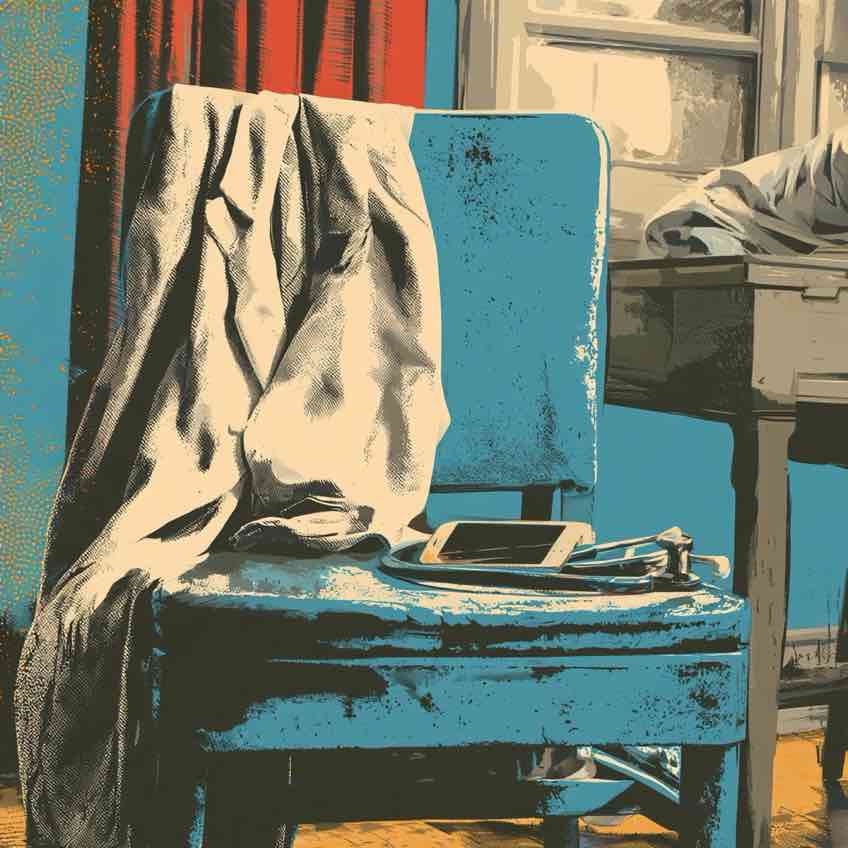
A stethoscope is perhaps the most obvious object a doctor could choose, which is precisely what makes it interesting. Its symbolism is so familiar that it can become almost invisible. Yet the individual instrument has been physically present for thousands of encounters. It has crossed the threshold into examination rooms and hospital rooms, accompanied uncertainty, routine, relief and bad news. Eventually, the generic object becomes a particular one: mine.
There are objects that document another part of medicine, too, one that is disappearing remarkably quickly.
For generations of physicians, learning left a physical trail. There were notebooks filled with handwriting, margins crowded with additions, index cards, highlighted textbooks, pocket references and pages whose importance could be inferred from their condition. Knowledge had weight. It occupied shelves and backpacks. It could be underlined.

A pen was part of the machinery of becoming a doctor.
Today, much of that machinery has moved behind glass. Notes are typed. Articles are stored in tabs. References live on phones. Lectures arrive as digital files and disappear into folders with names like “final,” “final2,” and “actually final.” The information remains. The physical evidence of having wrestled with it is becoming harder to find.
There is something unexpectedly intimate about old handwriting. A page can reveal urgency through the slant of the words, exhaustion through their deterioration, importance through repetition and underlining. Even the illegibility can summon a particular version of oneself. A physician looking at notes made twenty years ago may encounter an earlier mind trying very hard to understand something that later became automatic.
The objects we keep sometimes preserve versions of ourselves that our résumés have already edited out.
This may explain why objects associated with uncertain periods can become particularly difficult to discard.
Medical training is organized around milestones that appear orderly in retrospect. There was an application, a Match, a residency, perhaps a fellowship, a first job. Once the outcome is known, the sequence acquires inevitability. The person living through it had no such advantage. There were envelopes once, and phone calls, and lists, and emails refreshed too many times. There were decisions that seemed capable of changing everything.
An object from one of those periods can retain the uncertainty long after the uncertainty itself has passed. Hold it again and the future briefly becomes unknowable.
This is one of the stranger properties of possessions. They allow us to revisit an experience without fully returning to it. The object remains unchanged while its owner does not. Something once associated with anxiety can eventually evoke gratitude. Something connected to an exhausting period can become evidence that the period ended.
Other objects lead away from medicine entirely.
A physician’s most meaningful possession may belong to a child. It may come from a hobby, a relationship, a place visited once, or a life that exists alongside the professional one. These objects complicate the tidy identity implied by a white coat and a list of credentials. A trophy on a shelf can contain hours spent driving to practices, sitting in auditoriums, rearranging schedules, waiting backstage and showing up for somebody else’s ambition.
There is an entire life occurring around a medical career. Much of it never enters the professional biography.
Perhaps this is why patient notes and gifts can carry such disproportionate weight. They are small physical acknowledgments of encounters that medicine’s official systems record very differently. The chart retains diagnoses, orders, results and billing codes. A handwritten card may retain what the encounter meant to another human being.
Some clinicians keep those cards for decades.
They may rarely reread them. Their continued presence is enough. On difficult days, a box of old notes can function almost like an external memory, preserving evidence of meaning at precisely the moments when meaning becomes difficult to retrieve.
A few things survive every purge.
That may be the more revealing question. After years of acquiring the physical debris of a professional life, what keeps earning its place?
We recently began asking healthcare professionals a version of that question through #ONEOBJECT, a SoMeDocs video campaign (which you can take part in, too, right here) built around a simple prompt: choose one object and tell us its story. The responses have ranged across training, family, patients, uncertainty and the ordinary tools of medicine. Taken together, they begin to resemble a small, accidental archive of lives in healthcare.

The appeal of the exercise may come from how little explanation an object initially provides. Put a pen, a trophy, a stethoscope and a box of old cards on a table and they tell us almost nothing. Ask their owners why those particular things are still here, and whole chapters appear.
The object can be ordinary. The story is the point.
One day, long after the titles and dates have settled into their permanent places on a CV, somebody may open an old drawer and find an object that should have been thrown away years ago.
They will know immediately why it wasn’t.