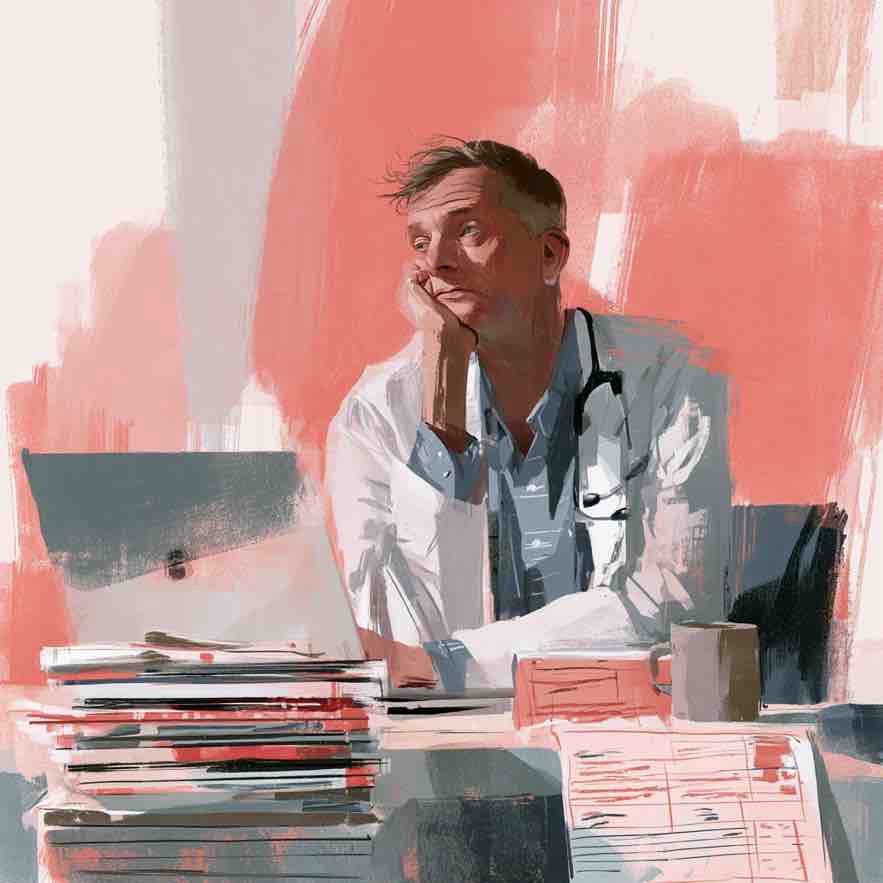
There are questions in medicine that sound perfectly reasonable until they are directed at you. “What’s your plan?” is one of them. Three ordinary words, delivered with the casual confidence of someone who has already survived medical school, residency, and several thousand variations of the very encounter you are now attempting to navigate. The attending may be leaning against a counter, scrolling through the electronic medical record, or sipping coffee. The question arrives without ceremony, and somewhere inside the trainee’s head, a small administrative department begins shredding documents.
The patient has been presented. The history was reasonably thorough. The physical examination included most of the relevant organs. The laboratory values were recited with admirable precision, including several that nobody particularly needed to hear. The trainee has successfully navigated the dangerous territory of the review of systems and even remembered to mention the patient’s allergies. There is a moment of satisfaction, perhaps even the faint suggestion of professional competence, before the attending asks what should happen next. Unfortunately, the plan was to ask the attending.
View this post on Instagram
When the attending asks for your plan, and your plan was to ask the attending. A familiar moment in medical training, above, captured by Joshua Estrada, PA (@joshuathepa).
Medicine has an unusual relationship with uncertainty. It is a profession built around making decisions with incomplete information, practiced by people who have spent an extraordinary amount of time being evaluated on how much information they can produce. The transition from classroom to clinical training introduces a particularly uncomfortable development: the correct answer is no longer conveniently waiting at the bottom of a multiple-choice question. In the classroom, there are five options, one of which is generally right. On the wards, there is a patient with three chronic conditions, an unreliable medication list, a mildly elevated creatinine, and a daughter who would like to know whether her mother can go home before lunch. The attending would also like to know, preferably before lunch.

The trainee, meanwhile, is performing a series of internal calculations that have very little to do with medicine. How long is an acceptable pause before answering? Is it better to begin with a confident statement or a tentative suggestion? Would ordering another test demonstrate thoroughness or merely advertise indecision? Is the attending looking for a particular answer, or is this one of those educational exercises in which the answer matters considerably less than the thinking that produces it? There is, of course, the possibility of simply admitting uncertainty, although for reasons that deserve their own psychological investigation, saying “I’m not sure” can feel considerably more dangerous than proposing an elaborate diagnostic workup.
What makes the exchange particularly interesting is that the attending has almost certainly occupied the other side of it. At some point, years earlier, this same physician stood beside a hospital bed, holding a folded patient list and attempting to remember whether the appropriate next step was imaging, observation, antibiotics, or a discreet disappearance into the supply closet. Medical training depends on an elaborate system of professional inheritance. Senior physicians teach junior physicians, who eventually become senior physicians and repeat the process. Clinical judgment is passed along through formal instruction, bedside demonstrations, difficult cases, and thousands of small conversations that rarely make their way into textbooks. The question “What’s your plan?” is part of that inheritance, repeated so frequently that it has become something of a professional ritual.
At its best, the question is an invitation to think. The attending is asking the learner to move beyond collecting information and begin assuming responsibility for interpreting it. The trainee must decide which findings matter, which possibilities deserve attention, and what should happen next. This is an essential transformation, because eventually every clinician must become comfortable making decisions without waiting for someone more experienced to provide the answer. Still, the educational value of the question depends considerably on the person asking it. An attending who responds to an imperfect plan with curiosity can turn a moment of uncertainty into a memorable lesson. Another who responds with ridicule may accomplish something quite different. Both interactions can remain with a trainee for years, although only one is particularly likely to encourage the kind of honest clinical reasoning that patients deserve.

Confidence is a peculiar currency in medicine. It can reassure patients, steady a team during an emergency, and help clinicians communicate decisions under pressure. It can also create an uncomfortable incentive for trainees to appear more certain than they actually are. Consider the student who has a reasonable differential diagnosis but remains unsure which condition is most likely, or the resident who suspects a patient needs additional evaluation but wants to discuss the risks before committing to a course of action. These are ordinary moments in the development of clinical judgment, yet the fear of looking unprepared can make them feel like professional failures. The ability to distinguish what one knows from what one merely suspects is among the most important skills a clinician can develop, although it rarely produces the sort of dramatic answer that earns immediate praise during rounds.
The best clinical teachers understand that uncertainty is useful information. They want to know what the learner is thinking, including where that thinking becomes less certain. An incomplete plan offers something to work with. It reveals assumptions, knowledge gaps, and opportunities for teaching, whereas a polished answer delivered without understanding may be considerably less useful. The challenge is creating an environment in which a trainee can expose those gaps without feeling that every admission of uncertainty will become part of a permanent professional record. A learner who fears embarrassment may become very skilled at concealing confusion, which is hardly the outcome anyone should want from medical education.
Perhaps this is why a short, funny social media reel can resonate so widely. The humor depends on an experience that crosses institutions, specialties, and generations. The details of medical training have changed, from the way information is accessed to the technology used to document patient encounters, but the sensation of being asked to produce a plan while desperately hoping someone else has one remains remarkably durable. Social media has given these small, previously private experiences a public audience, allowing clinicians to recognize themselves in moments they once assumed were uniquely embarrassing. A joke about rounds can become a conversation among medical students, physician assistants, residents, and seasoned attendings who remember their own early encounters with clinical responsibility.
There is a period in medical training when a student knows enough to recognize the complexity of a clinical problem but has not yet developed the experience to navigate it comfortably. The textbooks have grown more familiar, the terminology comes more easily, and the white coat no longer feels entirely like a costume. Yet each new rotation introduces another collection of unfamiliar expectations, personalities, and unwritten rules. Much of the learning happens in these awkward spaces, as a student proposes a plan, receives feedback, adjusts, and tries again. A resident recognizes a pattern that would have escaped them six months earlier. A clinician who once needed reassurance before every decision begins to notice that colleagues are now asking for their opinion. The transformation is gradual enough that it can be difficult to recognize while it is happening.
It also helps to have people around who remember what that stage feels like. Medical students have always built informal communities around the shared absurdities of training, trading stories about difficult rotations, intimidating questions, and the small victories that make the next day seem manageable. Increasingly, some of those conversations happen online, where students can connect with physicians and other healthcare professionals whose careers offer a glimpse of what comes after the next examination, rotation, or match. SoMeDocs has been making room for these exchanges through its student community, bringing future healthcare professionals into conversations with people at different stages of their careers. The questions that arise during training often extend well beyond the clinical material being taught, into professional identity, mentorship, communication, and the many possible directions a career in healthcare can take. There is something reassuring about discovering that the people who now seem entirely comfortable making clinical decisions once experienced the same hesitation.

Years later, the former trainee may find themselves on the other side of the exchange. They will have a patient to discuss, a junior colleague standing nearby, and a few minutes in which to understand how that colleague is thinking. The question will come naturally, perhaps without any awareness of its considerable emotional history. The student may glance at the chart, rearrange a few papers, or begin a sentence that takes an unexpected turn halfway through. The attending will recognize the expression because they have worn it themselves, and in that moment, they will have an opportunity to decide what kind of teacher they want to be.
The answer to “What’s your plan?” will always matter, especially when a patient’s care depends on it. But the exchange that follows may determine whether a trainee leaves the room more capable of answering the question the next time it comes around. Somewhere, on another rotation, another learner is standing beside a patient, carefully presenting the history and hoping the attending will be impressed by the thoroughness of the assessment. The presentation ends, the attending looks up, and three familiar words arrive. For a brief and terrible moment, the trainee remembers that the only plan they had was to ask the person who has just asked them.