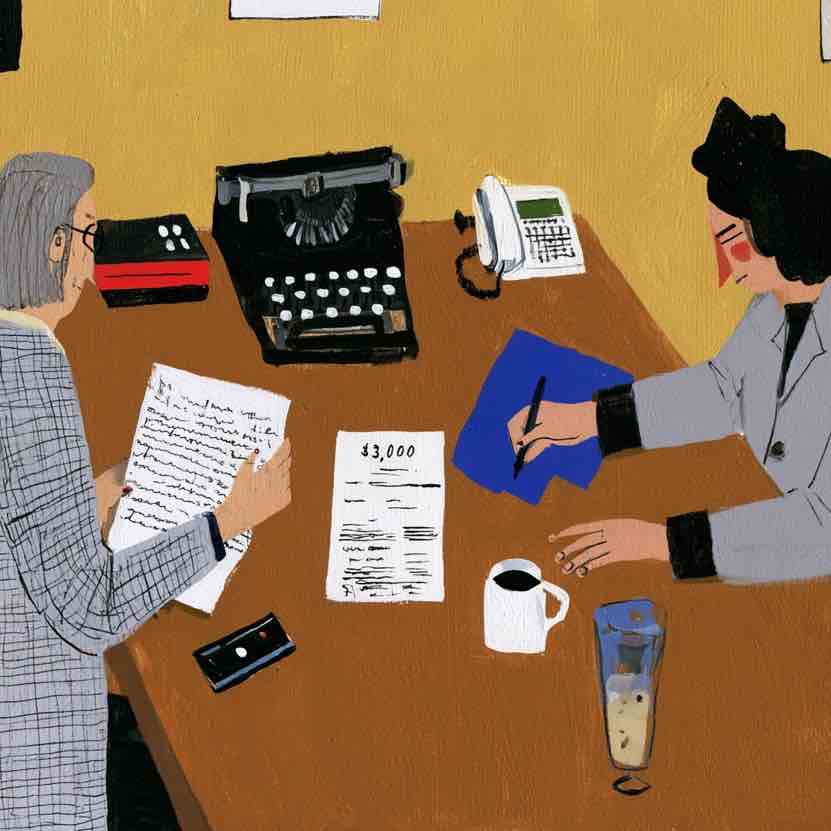
There is a peculiar kind of work that happens every day in American healthcare. A physician decides that a patient needs something. Somewhere else, another person or system decides whether that something will be paid for. Between those two decisions, an astonishing amount of human activity can occur.
Forms are completed. Records are transmitted. Codes are checked. Requests are reviewed. Questions are returned. Phones ring. People wait on hold. Additional documentation is requested. Someone schedules a peer-to-peer. A physician steps away from patients to explain to another clinician why the patient requires the treatment the physician has already documented that the patient requires. Sometimes permission arrives. Sometimes it does not. Sometimes the process begins again.
Each individual step can be explained. Taken together, they reveal something stranger: healthcare has built an enormous infrastructure around the possibility of saying no.
We started thinking about this after publishing a recent SoMeDocs article by Dr. Cesar Limjoco, who used the idea of the “Moloch trap” to examine the incentives operating within healthcare. The concept describes situations in which rational actors, each responding logically to the incentives in front of them, collectively produce an outcome that may serve almost no one particularly well. When we shared his article with our public community, the response was immediate. Readers began talking about insurance denials, prior authorization, administrative staffing, reimbursement, vertical integration, peer-to-peer reviews, executive compensation, EHRs, and the growing distance between the people delivering medical care and the machinery surrounding it.
The comments varied in tone and perspective, and they did not all come from physicians. Yet something interesting emerged when they were read together. People were describing an entire ecosystem of work that exists because healthcare organizations must continually negotiate with one another over whether something will happen, who will pay for it, how much they will pay, and what must be demonstrated before payment is allowed.
Consider the ordinary medical practice. Someone has to submit claims. Someone has to notice when those claims are rejected. Someone has to understand why. Someone may have to gather records, correct codes, obtain documentation, contact the insurer, appeal a determination, track the appeal, follow up when nothing happens, and tell the physician what additional action is required. Larger practices may have departments devoted to parts of this process. Hospitals have entire revenue-cycle operations. Insurers, meanwhile, employ their own people and systems to receive, evaluate, approve, question, and deny what arrives from the other side.
The result is an unusual economic arrangement. One organization employs people to ask for money. Another employs people to decide whether to give it to them. The first organization then employs additional people to challenge the second organization’s decision. The second organization needs processes for handling those challenges. Software is purchased to manage the exchanges. Consultants teach organizations how to navigate them. Vendors promise to automate them. Artificial intelligence is now being enlisted by multiple sides to make the whole negotiation faster.
We have become remarkably efficient at fighting over efficiency.

None of this means that every claim should simply be paid without scrutiny. Fraud exists. Waste exists. Medical care varies in quality and necessity, and finite resources require stewardship. Any serious discussion about administrative burden has to acknowledge why many of these mechanisms arose in the first place. A healthcare system spending trillions of dollars cannot operate on an honor system, and removing oversight altogether would create its own predictable problems. The more interesting question, however, is what happens when oversight itself becomes an industry.
Prior authorization offers perhaps the clearest example because its logic is easy to understand. Before paying for certain medications, procedures, tests, or services, an insurer may require evidence that the treatment meets specified criteria. From the perspective of a payer responsible for millions of healthcare decisions, this can look like prudent management. From inside a medical office, the same mechanism can look very different. It can mean staff members chasing approvals, physicians completing additional documentation, patients waiting, pharmacists calling, and clinicians interrupting their work to participate in reviews.
The cost of that process does not disappear simply because it is categorized as administration rather than medicine. Someone’s salary pays for every phone call. Someone’s workday contains every form. Every hour a physician spends arguing for authorization is an hour that cannot simultaneously be spent doing something else. Every employee hired primarily to navigate payment complexity represents money a practice must generate before that employee can be paid.


This is where our public discussion became particularly revealing. One commenter imagined a world in which practices could employ fewer people to manage claims because claims were routinely reimbursed without prolonged disputes. Another described prior authorization as a hurdle placed between physician and patient. Another pointed toward decades of increasing overhead. A reader whose husband graduated from medical school in 1973 described watching the balance of healthcare shift over the course of his career as administrative structures expanded around clinical work.
These are individual observations, rather than a controlled economic analysis, but collectively they point toward a question worth examining: how much healthcare labor now exists primarily to interact with other healthcare labor?
There is something almost architectural about the problem. One layer creates a requirement. Another layer appears to satisfy it. A third emerges to monitor compliance. Technology is purchased to make compliance manageable. When that technology produces new documentation demands, people are hired to manage those. Eventually the structure becomes so elaborate that removing any single component feels impossible because other components have been built around its existence.
Complexity acquires constituencies.

Secret Insurance Bonuses Undermine Healthcare for Us All
Secret bonus schemes that discourage hospital transfers in Medicare Advantage plans reveal how profit-driven care can endanger patients, erode trust, and make healthcare worse for us all.

The Unraveling: When Palliative Care Disappears
Dr. Schroll shares how the dismantling of a hospital’s interdisciplinary palliative care team left patients, families, and clinicians struggling with preventable crises, underscoring the profound harm caused when administrative cost-cutting overrides compassionate care.
This is where Dr. Limjoco‘s original framing becomes useful. Healthcare’s administrative machinery does not necessarily require a room somewhere in which people deliberately design the most cumbersome possible system. In fact, the opposite may be more unsettling. Much of the machinery can arise from organizations behaving rationally according to their own incentives.
An insurer wants to control unnecessary spending. A hospital wants to maximize reimbursement. A physician practice wants to be paid for work already performed. A regulator wants documentation demonstrating compliance. An employer wants predictable healthcare costs. A patient wants access to treatment. Each goal can be perfectly understandable on its own. Put them together, and the system begins generating defenses against the defenses created by everyone else.
The absurdity becomes clearest when we consider the ultimate source of the money. Administrative conflict does not occur outside the healthcare economy. It is part of the healthcare economy. The salaries, software, call centers, billing systems, authorization departments, compliance programs, appeals processes, and consultants all have to be funded somehow. The machinery used to control healthcare spending is itself healthcare spending.

And then there is the cost that is harder to put into a spreadsheet. A physician interrupted by another authorization request experiences the system as time. A practice owner experiences it as overhead. A staff member experiences it as another task in an already crowded day. A patient experiences it as waiting.
That may be the most important part of the conversation. Administrative complexity sounds remote when discussed in the language of healthcare economics. Inside an exam room, it becomes surprisingly intimate. It influences which medications can be prescribed easily, how long someone waits for a test, how many employees a practice can afford, how much time a clinician has available, and how much energy remains after the day’s visible work has ended.
The word “administrative” makes these consequences sound as though they occur somewhere down the hall. But increasingly, the hall leads directly back to the patient.

Perhaps the question, then, is larger than whether prior authorization is good or bad, whether insurers deny too much, or whether healthcare organizations employ too many administrators. Those debates matter, but they can obscure the more curious phenomenon sitting underneath them. We have constructed a healthcare economy in which enormous amounts of expertise, technology, money, and human attention are devoted to negotiating the boundaries of care rather than delivering it.
Every complicated system has reasons for becoming complicated. The harder question is whether anyone periodically looks at the finished structure and asks whether all those reasons still justify what has been built. Because somewhere today, a physician will decide that a patient needs something. Someone else will ask for proof. Someone will send it. Someone will review it. Someone may reject it. Someone will appeal. Someone will schedule a call. Someone will wait on hold.
And every one of those people will be working. The real (and uncomfortable) question is how much of that work should have needed to exist in the first place.