Dr. Roy-Bornstein has always been a writer. Before medicine, before nursing, before the accumulation of professional titles and personal roles, she was already building meaning by hand. As a child, she created “super-hero pop-up books with caped figures you could make fly by pulling tabs.” Her third-grade teacher supported that instinct by letting her write a poem each month on the side chalkboard in the classroom. For a brief moment, she was “the youngest poet published in Poetry Parade magazine,” a detail she now shares with a precise awareness of both its charm and its limits.
Eventually, another form of validation took hold. Dr. Roy-Bornstein earned strong grades in math and science, and those were the skills that drew praise. She followed them into nursing, working in a burn unit and pediatric ICU, and then into medical school and residency. She practiced in a large community health center and later in private practice, carrying her work through the coronavirus pandemic. From the outside, the path appears conventional, even exemplary. Yet alongside that trajectory, something else remained constant. “Although I pursued a life in science,” she writes, “my heart still lived in the arts.”
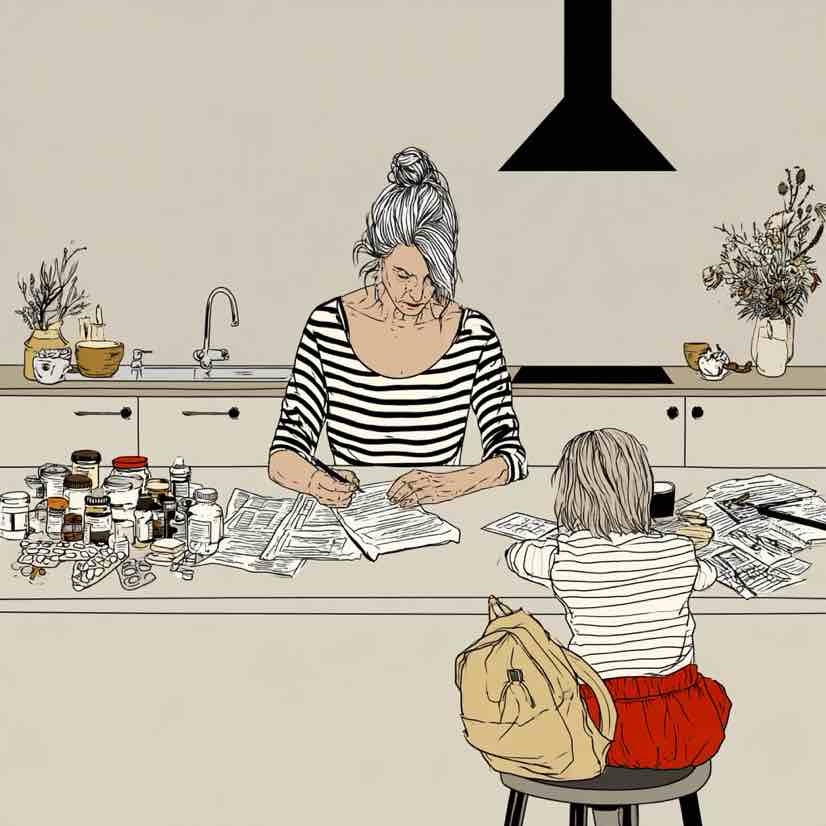
That duality (science and story, structure and reflection) runs through Dr. Roy-Bornstein’s life and work. While seeing patients and raising her family, first two sons and later two foster daughters, she continued to write about what she calls “those liminal spaces where my roles as mother, foster mother, and physician intersected.” Her writing did not emerge from distance. It emerged from proximity to experiences that resist simplification.

When her youngest son was hit by a drunk driver in a crash that killed his girlfriend and left him with a traumatic brain injury, writing became a way to process “my feelings of anger and loss and my disenfranchised grief as the mother whose child didn’t die in the accident.” Gratitude and devastation existed simultaneously, without canceling each other out. Later, when her youngest foster daughter struggled for more than a year in residential treatment for an eating disorder, Dr. Roy-Bornstein turned again to writing, describing it as a way to “collaborate with my fear and pain on the page.”
These experiences shaped not only what she wrote, but how she understands writing itself. Over time, she placed essays in The New York Times, The Washington Post, JAMA, Poets & Writers, The Writer, and many other publications. She wrote two memoirs. In the relief she experienced and the meaning she derived from that work, she “came to believe in writing as a therapeutic modality.”

That belief deepened as physician burnout became impossible to ignore. During the pandemic, when burnout among healthcare professionals reached what she describes as epidemic proportions, Dr. Roy-Bornstein decided to formally unite lived experience with scientific evidence. The result is A Prescription for Burnout: Restorative Writing for Healthcare Professionals, forthcoming from Johns Hopkins University Press in April 2026. The book is “an evidence-based and compassionate guide to writing our way back to meaning and joy, reconnecting us with our deepest values and transforming professional disillusionment into clarity, self-awareness, and purpose.”


Central to her approach is the idea of creative capacity. Referencing The Creativity Cure by Drs. Carrie and Alton Barron, she emphasizes that creativity is not a fixed talent but a universal human ability. As children, she notes, “we would never think, ‘Oh, I’m not a creative person.’ We just make things.” Over time, intimidation replaces curiosity. In her workshops and in her book, Dr. Roy-Bornstein tries to level the playing field, encouraging people to write without editing, without concern for grammar or spelling, allowing thoughts and feelings to move freely onto the page. She cites Theodore Roethke’s line, “I learn by going where I need to go,” as a framework for approaching both creative work and grief. If loss is present, there may be something to learn by engaging with it directly.
Her understanding of identity is similarly layered. “Every experience pushes us. Asks something of us.” Motherhood, she writes, teaches self-reliance. Foster motherhood introduces impermanence into a relationship that insists on constancy. Being a pediatrician places her in the role of witness-bearer – to suffering and to joy. Drawing on Rita Charon’s work in narrative medicine, Dr. Roy-Bornstein describes the necessary porousness of physicians: the capacity to absorb patients’ stories without being overtaken by them. Writing becomes the mechanism that allows her to metabolize those experiences, to “retain what is valuable, meaningful, but not hold on to what isn’t ours.”
The role that pushed her hardest as a writer was caregiving to her son after his traumatic brain injury. Alongside his losses and recovery, she confronted her own experience of grief that did not fit socially sanctioned narratives. When she tried to share her feelings, she was often met with the expectation that gratitude should eclipse everything else. “I was grateful. Of course I was grateful.” But gratitude did not negate anger or loss. Years later, at a writing conference, psychologists named what she had been experiencing: disenfranchised grief. That clinical language mattered. In this case, clarity arrived first through diagnosis, and then through writing, allowing her to articulate an experience that had previously been minimized.
Dr. Roy-Bornstein’s conviction that writing is physiologically restorative is grounded in both observation and research. Writing had always helped her process “big feelings,” clarify ideas, and understand experiences. She saw its effects amplified while keynoting conferences on brain injury, where sharing her story prompted others to share theirs. She witnessed it again while collaborating with Amy Newmark on a Chicken Soup for the Soul volume focused on traumatic brain injuries. Many contributors described writing as revelatory, some even expressing gratitude for experiences they had once seen only as obstacles. Reading and editing those stories added depth to her own family’s experience. “Stories matter. Stories inspire. Stories create community.”

For years, the idea of a book about writing as healing lingered without a clear audience. That changed during a quiet moment in a cabin in Maine, working through an exercise from Jennie Nash’s Blueprint for the Nonfiction Book Proposal. Asked to describe her ideal reader, Dr. Roy-Bornstein envisioned a surgeon her age, burned out, tempted to leave medicine but still feeling he had something to give. “That description was my lightning bolt.” She realized her audience was herself. After that, the work accelerated. She layered research on expressive writing’s effects on physical health with studies on burnout, empathy, and self-compassion in physicians. The book became, as she describes it, “a marriage of profound personal transformation with scientific evidence.”
Her language around fear is deliberate. Drawing on the work of Suleika Jaouad, Dr. Roy-Bornstein speaks of collaboration rather than avoidance. Collaboration means confronting fear, interrogating it, allowing it into the creative process. For artists, she suggests, engagement is not only a way to cope, but a way to transform fear into meaning that may help others.

When she reflects on what resonates most with readers, she returns to specificity. She teaches writers to “make the specific universal.” Not everyone has experienced traumatic brain injury or foster care, but everyone has worried about someone they love, sat at a bedside, or faced a moment that altered their life in an instant. Readers respond to recognition. In a healthcare system increasingly shaped by productivity metrics and administrative pressure, stories written by someone who has worked in a burn unit, pediatric ICU, emergency room, and community health center land differently. “I’ve been where you are. I hear you and see you.”
At the SoMeDocs Writers Conference, where Dr. Roy-Bornstein returns for her third year, she sees not just evolution but revolution. Healthcare professionals are increasingly open to reflection, to pausing amid relentless demands, to checking in with themselves. Writing, for her, becomes “the back door to the heart,” a way to let go of suffering that does not belong to us while preserving meaning and wisdom.
The misconception she most wants to dismantle is simple: “But I’m not a writer.” Restorative writing is not about polished prose. It is about expression, connection, and reclaiming voice. The requirement is not literary skill, but openness.
Her goal is to give healthcare professionals a tool that is portable, private, and perpetually available. Not simply to manage burnout, but to flourish. To live examined lives marked by curiosity, wonder, and connection. The enthusiastic response to her workshops (from medical societies to wellness retreats to international conferences) suggests that this message is being received. Writing, in Dr. Roy-Bornstein’s work, is not an escape from medicine. It is a way back to its deepest meaning.