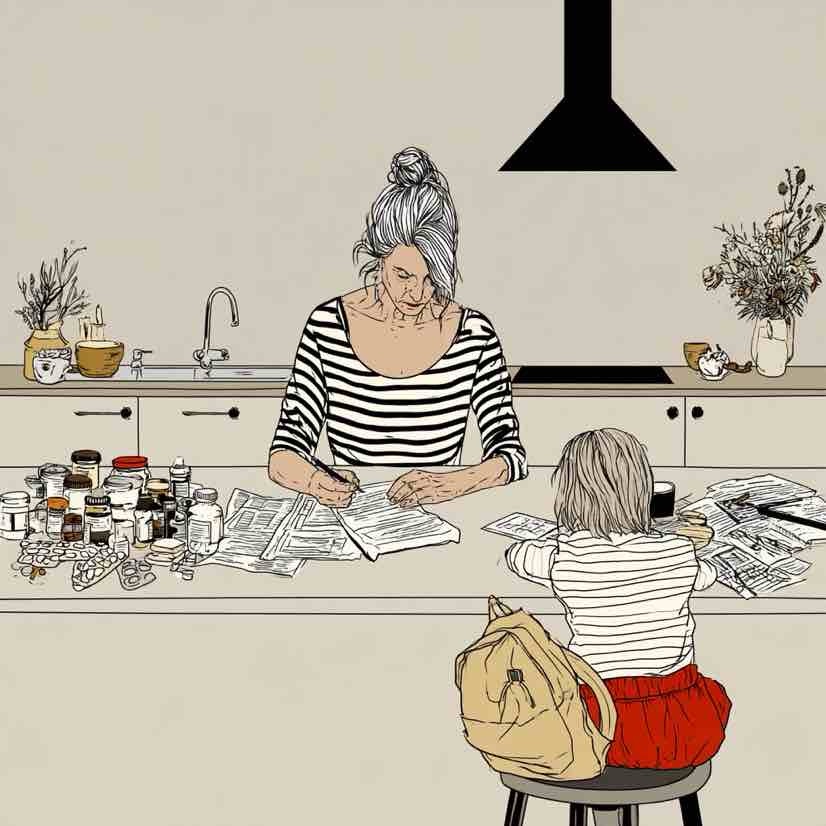
Female physicians talk about imposter syndrome constantly. We almost joke about how universal it is. (Almost.) We reassure each other perpetually too. We remind each other of our training, the sacrifices, the standardized exams we had to pass to even receive our degrees, our board certifications, the years we spent learning how to do this work. We tell one another that we belong in the room.
But lately I have been wondering whether we are naming and blaming the wrong problem.
What if some of what we call imposter syndrome is not an internal defect at all?
What if sometimes we feel as though we do not belong because the system we are standing inside no longer resembles or represents the profession we trained to enter?
Physicians are trained to diagnose. We gather data, look for patterns, assign names, revise those names when new evidence emerges, and try again. Medicine changes because science changes. Diagnoses change. Treatments change. Our understanding changes.

But perhaps we have taken that same instinct and turned it inward.
We feel alienated from medicine, so we diagnose ourselves.
Naturally, as female physicians do, we look inward for the correction.
Imposter syndrome.
It must be me. I don’t belong.
Something is wrong with me.
I am broken.
I am the pathology.

But perhaps the pathology is the system itself.
I have spent years leaving systems that required me to become less myself in order to remain inside them.
When I worked in hospital medicine, I eventually realized that I did not want to be the physician who briefly entered someone’s life during an admission and then disappeared until the next one, if the patient was even assigned to me as their doctor again. Patients kept telling me they needed to check with their primary care physician to make sure what I was recommending was “correct,” and I remember thinking: I want to be the trusted primary care physician. I want to know what happened before this hospitalization and what happens after it. And maybe even try to prevent and understand it.
I wanted continuity.
So I left hospital medicine.
Later, I left a major health system even though doing so meant walking away from tens of thousands of dollars. I could have stayed a little longer and collected the money. I did not want to stay another second, let alone tolerate another month. I simply could not do it anymore.

Of course I was generating revenue. (I always have.) I was valuable in the way large medical \(ystem\) know how to measure value. But I did not feel valued as a physician or as a human being.
There is a difference.
“Healthcare” increasingly measures physicians by productivity, revenue, patient volume, RVUs, throughput, documentation, coding, and efficiency. We are asked to see more patients in less time while somehow preserving the depth, attention, judgment, connection, and intellectual rigor that made many of us want to become physicians in the first place.
When we cannot tolerate that contradiction, we often assume something is wrong with us.
Maybe we are burned out.
Maybe we are too sensitive.
Maybe we are not resilient enough.
Maybe we cannot keep up.
Maybe everyone else has figured something out that we have not, because it sure feels like it.
Maybe we are the imposters.

But what if the discomfort is actually data for our bodies?
What if not fitting into a dysfunctional system is sometimes a sign that something in us is actually functioning correctly?
I think about the environments physicians have learned to accept as normal. Working without adequate space. Sleeping on the floor during overnight shifts between pages because the one call room hasn’t been cleaned since last month. Eating when there is time (there’s never time). Holding our bladders. Accepting and carrying impossible patient loads. Being responsible for life-altering decisions while being denied the time and foundational needs necessary to make them properly. Being told that our worth to an institution is reflected in the revenue we generate and the waves we avoid creating.
And then we wonder why physicians feel alienated from themselves.
Female physicians carry another layer of this. We are frequently expected to be excellent without appearing arrogant, authoritative without being threatening, warm without being weak, confident without being difficult, productive without appearing ambitious or greedy, and endlessly competent while remaining pleasant enough that nobody becomes uncomfortable with our competence.
Then we enter rooms where we have earned the right to be, feel the friction of all those competing expectations, and call the resulting sensation imposter syndrome.
Maybe some of it is.
But I no longer believe all of it is.
There is another possibility: we are perceiving the mismatch.
Perhaps this is where cognitive dissonance meets moral injury.
We are trying to practice medicine inside structures that precipitously interfere with the practice of medicine.
We are trying to heal people inside systems primarily designed around profit, reimbursement, liability, throughput, corporate consolidation, administrative growth, and financial survival, all while keeping those who make up the system small.
We are trying to remain scientists while watching facts themselves become skewed and politicized.
We are trying to make thoughtful clinical decisions while simultaneously imagining how those decisions might later be interpreted by a boss who has zero medical training, an insurance company, an administrator, an attorney, a licensing board, a jury, a social media audience, and now AI.
At some point, practicing medicine begins to feel less like practicing medicine and more like surviving. Well. Life.
That distinction has been occupying my mind a lot lately.

I have spent much of my career trying to build alternatives and much of my life leaving broken systems. I left systems that did not fit or felt abusive or harmed me. (That includes relationships.) I built my own practice. I have been building new models of care. I have thought about ways physicians can regain our autonomy and retain survivability. I have wanted to teach other physicians that employment inside a large institution is not the only available life.
For a long time, I thought I was trying to build a better way to practice medicine.
I think I am beginning to understand that I have been building something else too.
I have been trying to build a life that can survive. Period.
A life in which my income does not depend entirely on one institution.
A life in which my professional identity is not controlled entirely by an employer.
A life in which patients have another route to care and learn there are other ways to receive it.
A life in which physicians can remember that their intelligence, training, judgment, autonomy, and creativity belong to them and have actual worth.
A life in which leaving a dysfunctional system does not mean losing the ability to practice medicine to the fullest extent of our degrees.
Maybe that is the larger challenge facing physicians now: not simply learning how to survive inside broken systems, but learning how to become less dependent on them.
Which includes letting them stop defining us.
Because perhaps the goal was never to become better at fitting into structures that are hurting us.
Perhaps the goal is to build enough outside them that we can comfortably exhale again.
And perhaps some of what we have been calling imposter syndrome is not a failure of confidence, but a failure of expectations and promises, and grief over the loss of our beliefs and our dream.
“What if you don’t need more confidence? What if you need another way out? Maybe you were never the pathology.”
Perhaps it is the moment when a female physician looks around and realizes:
I am not the thing that does not belong here, and this feels bad and wrong.
I’m going to leave, because I belong elsewhere.
I have an identity.
The imposter is not me.